Download AWS Certified Advanced Networking - Specialty.ANS-C01.ExamTopics.2025-07-28.257q.vcex
| Vendor: | Amazon |
| Exam Code: | ANS-C01 |
| Exam Name: | AWS Certified Advanced Networking - Specialty |
| Date: | Jul 28, 2025 |
| File Size: | 420 KB |
| Downloads: | 1 |
How to open VCEX files?
Files with VCEX extension can be opened by ProfExam Simulator.
Discount: 20%

Demo Questions
Question 1
A legacy, on-premises web application cannot be load balanced effectively. There are both planned and unplanned events that cause usage spikes to millions of concurrent users. The existing infrastructure cannot handle the usage spikes. The CIO has mandated that the application be moved to the cloud to avoid further disruptions, with the additional requirement that source IP addresses be unaltered to support network traffic-monitoring needs. Which of the following designs will meet these requirements?
- Use an Auto Scaling group of Amazon EC2 instances behind a Classic Load Balancer.
- Use an Auto Scaling group of EC2 instances in a target group behind an Application Load Balancer.
- Use an Auto Scaling group of EC2 instances in a target group behind a Classic Load Balancer.
- Use an Auto Scaling group of EC2 instances in a target group behind a Network Load Balancer.
Correct answer: D
Question 2
A company's IT Security team needs to ensure that all servers within an Amazon VPC can communicate with a list of five approved external IPs only. The team also wants to receive a notification every time any server tries to open a connection with a non-approved endpoint.
What is the MOST cost-effective solution that meets these requirements?
- Add allowed IPs to the network ACL for the application server subnets. Enable VPC Flow Logs with a filter set to ALL. Create an Amazon CloudWatch Logs filter on the VPC Flow Logs log group filtered by REJECT. Create an alarm for this metric to notify the security team.
- Enable Amazon GuardDuty on the account and the specific Region. Upload a list of allowed IPs to Amazon S3 and link the S3 object to the GuardDuty trusted IP list. Configure an Amazon CloudWatch Events rule on all GuardDuty findings to trigger an Amazon SNS notification to the security team.
- Add allowed IPs to the network ACL for the application server subnets. Enable VPC Flow Logs with a filter set to REJECT. Set an Amazon CloudWatch Logs filter for the log group on every event. Create an alarm for this metric to notify the security team.
- Enable Amazon GuardDuty on the account and specific Region. Upload a list of allowed IPs to Amazon S3 and link the S3 object to the GuardDuty threat IP list. Integrate GuardDuty with a compatible SIEM to report on every alarm from GuardDuty.
Correct answer: A
Question 3
The Security department has mandated that all outbound traffic from a VPC toward an on-premises datacenter must go through a security appliance that runs on an Amazon EC2 instance.
Which of the following maximizes network performance on AWS? (Choose two.)
- Support for the enhanced networking drivers
- Support for sending traffic over the Direct Connect connection
- The instance sizes and families supported by the security appliance
- Support for placement groups within the VPC
- Security appliance support for multiple elastic network interfaces
Correct answer: BC
Question 4
A Network Engineer needs to be automatically notified when a certain TCP port is accessed on a fleet of Amazon EC2 instances running in an Amazon VPC.
Which of the following is the MOST reliable solution?
- Create an inbound rule in the VPC's network ACL that matches the TCP port. Create an Amazon CloudWatch alarm on the NetworkPackets metric for the ACL that uses Amazon SNS to notify the Administrator when the metric is greater than zero.
- Install intrusion detection software on each Amazon EC2 instance and configure it to use the AWS CLI to notify the Administrator with Amazon SNS each time the TCP port is accessed.
- Create VPC Flow Logs that write to Amazon CloudWatch Logs, with a metric filter matching connections on the required port. Create a CloudWatch alarm on the resulting metric that uses Amazon SNS to notify the Administrator when the metric is greater than zero.
- Install intrusion detection software on each Amazon EC2 instance and configure it to use the AWS CLI to publish to a custom Amazon CloudWatch metric each time the TCP port is accessed. Create a CloudWatch alarm on the resulting metric that uses Amazon SNS to notify the Administrator when the metric is greater than zero.
Correct answer: A
Question 5
A network engineer deploys an application in a private subnet in a VPC that connects to many external video feed providers using RTMP over the internet. A NAT gateway has been deployed in a public subnet and is working as expected. From the Amazon EC2 instance, the application is able to connect to all feed providers except one, which hangs when connecting. Manually testing a connection from an Amazon EC2 instance in the public subnet to the problem feed indicates that the feed works as expected.
What is causing this issue?
- The NAT gateway does not support fragmented packets.
- The internet gateway only supports an MTU of 1500 bytes.
- An Amazon EC2 instance expects to communicate with an MTU of 9001.
- The security group on the instances does not allow PMTUD.
Correct answer: D
Question 6
A company has an application running in an Amazon VPC that must be able to communicate with on-premises resources in a data center. Network traffic between AWS and the data center will initially be minimal, but will increase to more than 10 Gbps over the next few months. The company's goal is to launch the application as quickly as possible.
The network engineer has been asked to design a hybrid IT connectivity solution.
What should be done to meet these requirements?
- Submit a 1 Gbps AWS Direct Connect connection request, then increase the number of Direct Connect connections, as needed.
- Allocate elastic IPs to Amazon EC2 instances for temporary access to on-premises resources, then provision AWS VPN connections between an Amazon VPC and the data center.
- Provision an AWS VPN connection between an Amazon VPC and the data center, then submit an AWS Direct Connect connection request. Later, cut over from the VPN connection to one or more Direct Connect connections, as needed.
- Provision a 100 Mbps AWS Direct Connect connection between an Amazon VPC and the data center, then submit a Direct Connect connection request. Later, cut over from the hosted connection to one or more Direct Connect connections, as needed.
Correct answer: C
Question 7
A company has recently established an AWS Direct Connect connection from its on-premises data center to AWS. A Network Engineer has blocked all traffic destined for Amazon S3 over the company's gateway to the internet from its on-premises firewall. S3 traffic should only traverse the Direct Connect connection.
Currently, no one in the on-premises data center can access Amazon S3.
Which solution will resolve this connectivity issue?
- Configure a private virtual interface on the Direct Connect connection. Update the on-premises routing tables to choose Direct Connect as the preferred next hop for traffic destined for Amazon S3.
- Establish an S3 VPC endpoint for the company's Amazon VPC. Configure a private virtual interface on the Direct Connect connection. Update the on-premises routing tables to choose Direct Connect as the preferred next hop.
- Configure a public virtual interface on the Direct Connect connection. Update the on-premises routing tables to choose Direct Connect as the preferred next hop for traffic destined for Amazon S3.
- Configure a public virtual interface on the Direct Connect connection. Establish an AWS managed VPN over the connection. Update the on-premises routing tables to choose the VPN connection as the preferred next hop.
Correct answer: C
Question 8
A company provisions an AWS Direct Connect connection to permit access to Amazon EC2 resources in several Amazon VPCs and to data stored in private Amazon S3 buckets. The Network Engineer needs to configure the company's on-premises router for this Direct Connect connection.
Which of the following actions will require the LEAST amount of configuration overhead on the customer router?
- Configure private virtual interfaces for the VPC resources and for Amazon S3.
- Configure private virtual interfaces for the VPC resources and a public virtual interface for Amazon S3.
- Configure a private virtual interface to a Direct Connect gateway for the VPC resources and for Amazon S3.
- Configure a private virtual interface to a Direct Connect gateway for the VPC resources and a public virtual interface for Amazon S3.
Correct answer: D
Question 9
A company has two redundant AWS Direct Connect connections to a VPC. The VPC is configured using BGP metrics so that one Direct Connect connection is used as the primary traffic path. The company wants the primary Direct Connect connection to fail to the secondary in less than one second.
What should be done to meet this requirement?
- Configure BGP on the company's router with a keep-alive to 300 ms and the BGP hold timer to 900 ms.
- Enable Bidirectional Forwarding Detection (BFD) on the company's router with a detection minimum interval of 300 ms and a BFD liveness detection multiplier of 3.
- Enable Dead Peer Detection (DPD) on the company's router with a detection minimum interval of 300 ms and a DPD liveliness detection multiplier of 3.
- Enable Bidirectional Forwarding Detection (BFD) echo mode on the company's router and disable sending the Internet Control Message Protocol (ICMP) IP packet requests.
Correct answer: B
Question 10
A company's network engineering team is solely responsible for deploying VPC infrastructure using AWS CloudFormation. The company wants to give its developers the ability to launch applications using CloudFormation templates so that subnets can be created using available CIDR ranges.
What should be done to meet these requirements?
- Create a CloudFormation template with Amazon EC2 resources that rely on cfn-init and cfn-signals to inform the stack of available CIDR ranges.
- Create a CloudFormation template with a custom resource that analyzes traffic activity in VPC Flow Logs and reports on available CIDR ranges.
- Create a CloudFormation template that references the Fn::Cidr intrinsic function within a subnet resource to select an available CIDR range.
- Create a CloudFormation template with a custom resource that uses AWS Lambda and Amazon DynamoDB to manage available CIDR ranges.
Correct answer: C
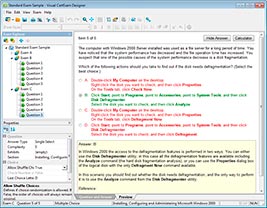
HOW TO OPEN VCE FILES
Use VCE Exam Simulator to open VCE files
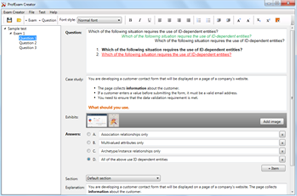
HOW TO OPEN VCEX AND EXAM FILES
Use ProfExam Simulator to open VCEX and EXAM files
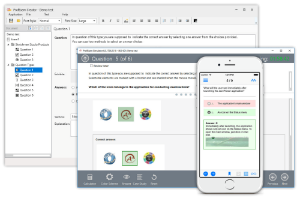
ProfExam at a 20% markdown
You have the opportunity to purchase ProfExam at a 20% reduced price
Get Now!